Tag Archives: Artsakh

The Man Who Walked on The Moon Can’t Walk on Azerbaijan

Charles Duke Azerbaijan Nagorno-Karabakh Demotivator by Kornelij

One of the 12 people who have walked on the moon – American astronaut Charles Duke will be included in the list of undesirable people in Azerbaijan as he “illegally visited” the breakaway Nagorno-Karabakh Republic, which Azerbaijan considers its territory for some reason. Continue reading

About these ads

Karabakh Armenians Hold Military Parade

This slideshow requires JavaScript.

Scores of troops, tanks, artillery systems and other military hardware paraded across Stepanakert on May 9 in one of the largest ever displays of Nagorno-Karabakh’s military power.

Watch the full slide-show here.

NK marks Independence Day

Nagorno-Karabakh Republic marks the 19th anniversary of its independence today. Official celebrations started with military parade, a number of exhibitions and monuments are to be opened later on.

Karabakh’s independence is not recognized by any state, including Armenia. However, the official delegation of the Republic of Armenia will take part in the celebrations, headed by Prime Minister Tigran Sargsyan. Continue reading

The Backbone of Karabakh


The North-South Highway, referred to as “The Backbone of Karabakh,” unites the entire Nagorno-Karabakh region through solid infrastructure facilitating economic, political and cultural development.

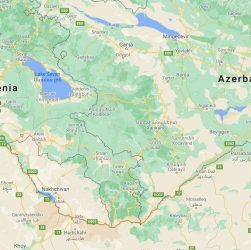
The ‘correct’ and ‘incorrect’ maps of Armenia and Karabakh

The 'correct' map of Armenia and Nagorno Karabakh

The 'correct' map of Armenia and Nagorno Karabakh

The 'incorrect' map of Armenia and Nagorno Karabakh

The 'incorrect' map of Armenia and Nagorno Karabakh

I came across today a Facebook group which, according to its description, is “dedicated to the promotion of using correct maps of Armenia and Artsakh.” The group’s description further runs:

When using or displaying a map of Armenia, Artsakh should not be left out! They are Armenian lands that should be properly included into every single map published. We live there, we govern it, we liberated it and therefore it is an integral part of the Armenian world.

With rather detailed descriptions, the group further explains the use of the terms ‘correct’ and ‘incorrect’ maps, saying the ‘correct’ one should “show Armenia and Artsakh as united” and not depict Karabakh “as an enclave, which is not the case.” Continue reading

21 Years Since The Start of Karabakh Movement

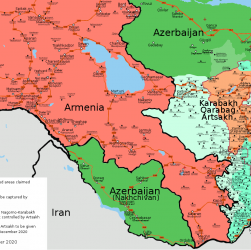
On February 20, 1988 a decision was adopted in the extraordinary  seesion of Nagorno-Karabakh region’s Council of People’s Deputies to present a petition to the government bodies of Azerbaijani and Armenian SSRs to hand over the NKAR to Armenia.

The maps below via Pigh illustrate the situation on this date, which marked the start of the Karabakh Movement and today.


My Big, Fat, Armenian Wedding! …in Karabakh

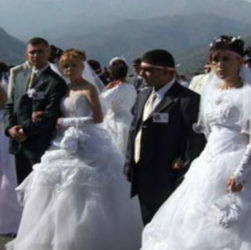
An unprecedented wedding ceremony, which married 675 new couples, took place in Nagorno-Karabakh Republic on October 16. The ceremonies took place in St. Ghazanchetsots church of Shoushi and ancient Gandzasar monastery of Martakert. The Karabakh wedding, followed by a solemn dinner and issuance of wedding certificates and wedding gifts in Stepanakert’s republican stadium, was implemented with the initiative of Russian businessman of Karabakh descent – Levon Hairapetyan, who was also the main sponsor of the event.

The couples were presented ‘golden’ banking cards with $2500 worth of AMD on the balance for each new family to spend. The beneficiaries have also thought about future children: following the birth of the first child the family will receive $2000, the second child – $3000, third child – $5000, fourth – $10,000, fifth – $20,000, sixth – $50,000, seventh – $100,000. That’s plenty of reasons for 675 children to be born in Artsakh next year – 2000 reasons starting from the first child ;)

The fact is – Karabakh has a serious population problem, and similar steps are the surest way to tackle it. Earlier this year Hetq published an article which adds another dimension to this story:

All this commotion is not only the result of the planned collective wedding event but also due to the government’s program unveiled in January of this year that calls for providing gifts of 300,000 drams to newly wed couples. To this end the Karabakh government has earmarked 450 million drams out of the 2008 state budget to be allocated to some 1,500 couples. However, it is already apparent that the number of couples that will register to get married this year will exceed this number. This became clear back in April when figures at the NKR National Statistical Agency showed the number of couples registering for marriage at 1,887. This compares to 224 couples during the same period in 2007. Interestingly, a portion of these 1,887 couples have already gotten hitched but the marriages were never properly registered in order that they are able to take advantage of the government’s largesse. In 2007 there were 519 marriages registered in Karabakh and 827 in 2006.

Apart from ensuring record number of marriages and most probably – a boom in next year’s child birthrates, this event will also serve the important purpose of establishing long-lasting relationships between donors and Karabakhis – given the fact, that the beneficiaries of the event are also becoming Godfathers for the newly formed families. No wonder, that the President of Karabakh Bako Sahakyan spoke on the event stressing it’s importance for the country. Overall – this has been the best piece of news I’ve heard so far this year.

Photos via: 517design

Georgia-Russia war buries hopes for Armenia’s independence

The world is filled with comment and analysis about the Georgian-Russian war and while the active military actions have ceased, the information war is going on full speed. The Guardian has been my main source of information throughout the past 5-6 days of armed conflict in Georgia, along with the Russian version of the BBC, which was a great deal more balanced than its English language version. At any rate, this analysis by BBC’s Paul Reynolds has captured the essence and reality of the Georgia conflict in short and simple formulations, which are hard to disagree with. Observe the following balance sheet:

Winners Losers
1. Russia

2. Prime Minister Vladimir Putin

3. The South Ossetians

4. Old Europe

1. The dead and wounded and the refugees, of course

2. President Saakashvili of Georgia

3. The truth

4. The West

The calculation of winning points and losses is still on and looking at how effective the western propaganda means like BBC and CNN are at disseminating cleverly designed half-truths, Saakashvili might just be able to turn this defeat into a victory.

Meanwhile, Armenia kept an uneasy silence throughout the clash of its two vital partners – Georgia, the main trade route to the world and Russia, the actual owner of this country (Armenian gas, electricity, communications infrastructure, railways are all controlled by Russian companies, Russian army guards Armenia’s border with Turkey).

There were a couple of vague and failed attempts to provoke and involve Armenia into the conflict in Georgia. The first of such attempts was the claim that the Russian warplanes bombing the military airfield near Tbilisi had actually taken off from the Russian airbase situated in Gyumri, Northern Armenia. Following refutations from Armenia, Georgian and Russian sources, the news died down, but the damage was done and Russian bases in Armenia were seen as a potential threat. Armenia was once again depicted as the Russian fore-post in the Caucasus – not that it needed proving or any further publicity. A second false rumor concerned the Armenians in Georgia’s Javakheti region – a nationalist Russian website claimed, that Georgia is planning ethnic cleansing in this mostly Armenian populated area, and that Armenians are gathering into armed groups to defend themselves. And although Armenia successfully avoided any involvement into the Georgia-Russia conflict, there are already sings, that the developments have left great impact on us. Making the assumption, that independence and physical safety of citizens are the key assets of a nation, here are some points for us to consider:

  1. We are hanging out with the strongest guy on our block – Russia showed the world who is the boss in the South Caucasus. Sadly though, the big guy has a nasty character – any attempts to demonstrate independence will result in severe punishment. There goes our independence…
  2. There was strong militaristic sentiment in Azerbaijan on the first day of the conflict, when Georgia attacked South Ossetia. Many in Baku were suggesting Azerbaijan should act by force, just like Georgia and attack Nagorno-Karabakh – a seemingly similar breakaway region of Azerbaijan. Following Russia’s violent response, calls for war toned down in Azerbaijan. However, looking at things more realistically, we will see that South Ossetia has nothing to do with Nagorno-Karabakh. There are no Russian peacekeepers standing on the border and Azerbaijan’s Ilham Aliyev has so far been much more balanced in its attitude towards the West and Russia, than his Georgian counterpart, so Russia has no reason to ‘punish’ Azerbaijan if it attacks Armenia, even though Armenia is part of the Collective Security Treaty Organization and Azerbaijan isn’t. With the Georgian invasion Russia has proved all it needs to the West already, so it will have nothing to gain and everything to loose by defending Armenia against Azerbaijan. There goes the physical safety…

…and especially for those who believe in ‘collective security treaties’ and century long friendship of Armenians and Russians, my response will be short – LOL!

Armenians looking to improve economy of region linking Karabakh to Armenia

Stepanakert, 29 March: A three-day conference is being held in the centre of the Kashatagh (Lacin) region of the Nagornyy Karabakh republic to discuss the region’s development issues.

“The fact that you are now here and are attending this very important event shows that our sisters and brothers in various parts of the world are inseparable from the fate of Kashatagh, and consequently, from the fate of Armenia and Artsakh [Nagornyy Karabakh]. This conference, dedicated to Kashatagh’s development, is the first one of this type, and I hope that it will become a basis for holding such events in the future. This will promote an effective solution to problems in the region and the implementation of projects aimed at further development,” NKR president Bako Sahakyan said while addressing the opening of the conference.

Sahakyan said that “the Kashatagh region is of great strategic importance to the whole Armenian people”. “It is no accident that our rival [referring to Azerbaijan] had turned this territory into a wedge between Armenia and Artsakh for about 70 years. Since May 1992, the role of this region changed sharply, and the section which was liberated during that period became a real ‘road of life’ for the people of Artsakh. Realizing both the political and economic significance of Kashatagh and our responsibility for its future, we must all get involved in the development of the region, establish a stable and competitive economy, increase the level of the people’s well-being and improve the living standards of people. This is the imperative for today, and this is required by the interests of our national security,” Sahakyan said.

At the same time, the Karabakh president said that the “existence of a strong, developed and populated Kashatagh creates stable conditions for the strengthening of our positions both in the negotiations process on the Karabakh conflict and on the front line, making it more protected and safer”.

“Funds allocated to the region’s development will increase considerably this year and in the coming years. The Kashatagh region’s budget for 2008 is 3.7bn drams [about 12m dollars], which exceeds last year’s figure by about 40 per cent. One billion drams [about 3m dollars] are planned to be spent on capital construction and 400m drams [about 1.3 m dollars] on the sphere of capital investment. These tendencies of proportionate development will be maintained in the future as well,” Sahakyan said. The president also said that apart from the region’s economic development, reforms are planned to improve the social condition of the population.

The conference is attended by representatives of 40 organizations of the Armenian diaspora, as well as individual businessman and philanthropists.

[Editorial note: Azerbaijan's Lacin District (Armenian name Kashatagh), which was captured by Armenians in 1992, links the breakaway region of Nagornyy Karabakh to Armenia]

Source: Arminfo, Yerevan, in Russian 0903 gmt 29 Mar 08